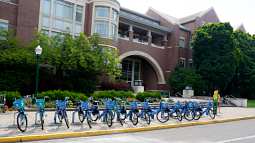
Oregon Law has wheeled its way onto the list of the nation’s most bike-friendly law schools, according to a post by Tax-Prof Blog, which highlighted Eugene’s cycling culture and protected bike lanes.
Honoring their significant contributions as educators, scholars, and leaders, Oregon Law awarded endowed positions to four members of the faculty at the start of the 2026-27 academic year.
Clinical Professor Joan Rocklin, a member of the Oregon Law faculty for 25 years, is the new faculty director for the Legal Research and Writing Program.
Oregon Law Associate Professor Greg Dotson developed an interdisciplinary course with University of Oregon Computer Science Professor Jun Li on data centers.
Clinical Professor Rebekah Hanley, a national authority on integrating generative artificial intelligence into legal education, received the Legal Writing Institute’s (LWI) 2026 Mary S. Lawrence Innovation Award.
From the classroom to Nike HQ, Oregon Law’s new sports law program is already making moves. Launched in 2025 and led by Associate Professor David P. Weber, a nationally recognized expert in name, image, and likeness (NIL) law, the program blends academics and real-world experience to prepare the next generation of sports attorneys.
Three Oregon Law faculty members have received University of Oregon and law school awards recognizing exceptional teaching and sustained leadership in legal education.
This March, student volunteers again planned Oregon Law’s Public Interest Environmental Law Conference, the largest and longest running event of its kind. This year marked the 44th year for the annual conference, which was organized around the theme “Fight Back, Voices for Good.”